Someone you love has died. There is a bank account, maybe a car, and every institution wants a court order before it will release a dollar. You have heard probate takes a year or more. For many Florida families it does not have to. Here is how summary administration works and whether it fits your situation.
What is summary administration in Florida probate?
Summary administration is Florida’s shortened probate process. No personal representative is appointed. The court enters one order distributing the assets. Since July 1, 2026, it applies when the nonexempt estate is $150,000 or less, or the person died more than two years ago.
That is the short version. The longer version matters, because the petition carries real obligations and the people who sign it carry real exposure.
In formal administration, the court appoints a personal representative who gathers the assets, publishes notice to creditors, waits out the claims period, pays valid debts, files an inventory, and then asks permission to distribute. That is the right tool for large or contested estates. It is a heavy tool for a $60,000 checking account.
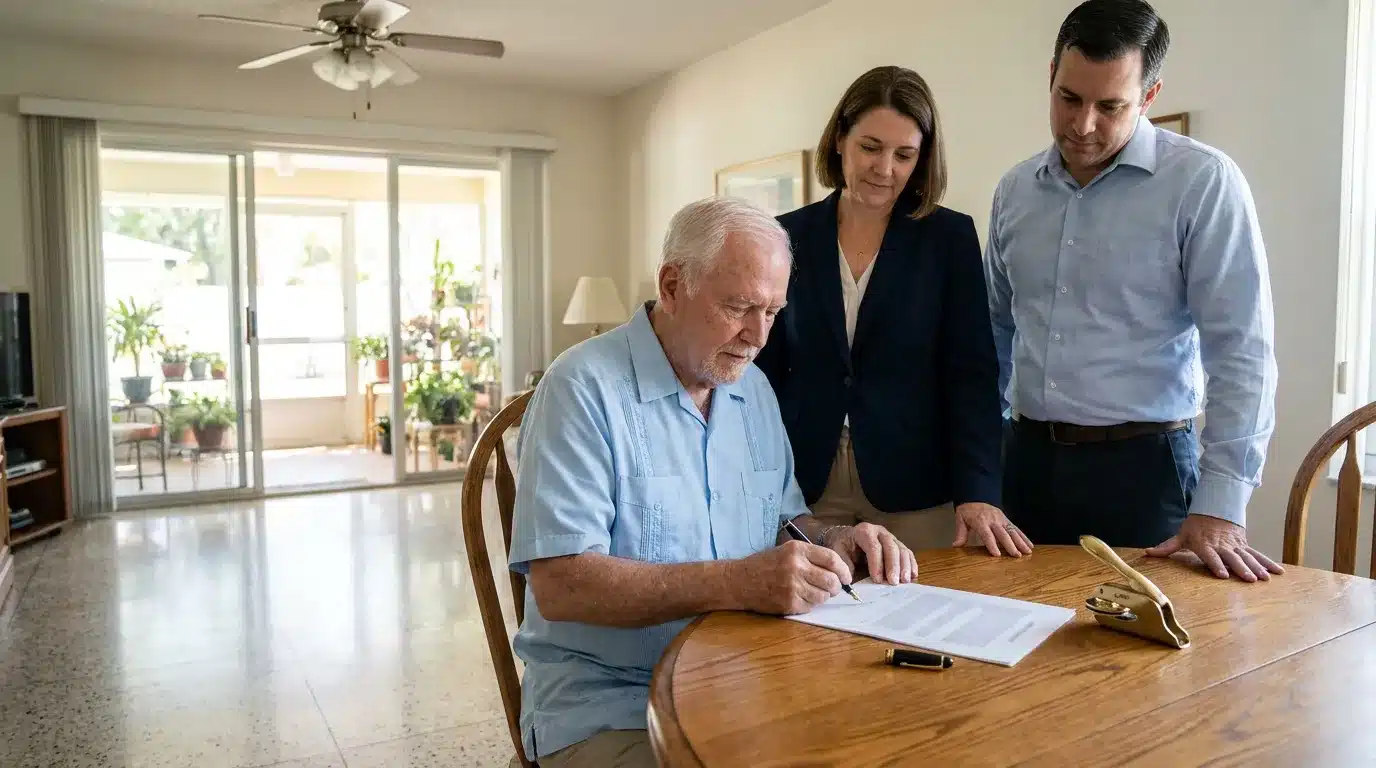
Summary administration skips most of that. There are no letters of administration and no one serves as personal representative. The beneficiaries, or those who will receive the property, go to the court together and ask for an order that says who gets what. Once the judge signs it, banks and other holders can pay out on the strength of that order.
Setting: The Florida Legal Framework
Summary administration lives in Part II of Chapter 735 of the Florida Statutes. The qualifying test is section 735.201. It allows summary administration when, in a testate estate, “the decedent’s will does not direct administration as required by chapter 733,” and when “the value of the entire estate subject to administration in this state, less the value of property exempt from the claims of creditors, does not exceed $150,000 or that the decedent has been dead for more than 2 years.” Fla. Stat. § 735.201.
The $150,000 figure is new. Before this year the ceiling was $75,000. The Legislature doubled it in CS/HB 1337, which became chapter 2026-57, Laws of Florida, effective July 1, 2026. The same law raised the limit for intestate personal property that can pass without any administration under section 735.304 from $10,000 to $20,000. The act does not state in plain terms whether the new $150,000 ceiling reaches a person who died before July 1, 2026. If your family member died before that date and the estate falls between $75,000 and $150,000, get that question answered before you file.
Who files is set by section 735.203. Any beneficiary, or the person nominated as personal representative in the will, may file. Paraphrasing the statute: the surviving spouse and the beneficiaries must sign and verify the petition, except a beneficiary who will receive a full share under the proposed distribution does not have to join. A beneficiary who does not join must receive formal notice. Florida Probate Rule 5.530 governs the petition itself.
The Problem: What Clients Face in Palm Beach County
Families in Palm Beach County usually come to us after the first wall. The bank says it needs letters or an order. The brokerage says the same. The car sits in the driveway with a title no one can transfer. Bills keep arriving in the name of a person who is gone.
The second wall is the paperwork. Summary administration is shorter than formal probate, but it is not a form you fill out in an afternoon. The petition must be verified, which means signed under oath. It has to lay out the assets, the people entitled to them, and a proposed distribution. If there is a will, it must be proved and admitted to probate. Fla. Stat. § 735.206(1).
The third wall is creditors, and this is where families get hurt. Before the court enters the order, section 735.206(2) requires that “the petitioner shall make a diligent search and reasonable inquiry for any known or reasonably ascertainable creditors, serve a copy of the petition on those creditors, and make provision for payment for those creditors to the extent that assets are available.”
Skip that step and the risk lands on the people who signed. A known or reasonably ascertainable creditor who did not get notice, and whose claim was not provided for, can enforce the claim later. If that creditor wins, the court awards reasonable attorney’s fees against those who joined in the petition. Fla. Stat. § 735.206(4)(d). Everyone who receives property under the order is “personally liable for a pro rata share of all lawful claims against the estate of the decedent, but only to the extent of the value of the estate of the decedent actually received by each recipient,” excluding exempt property. Fla. Stat. § 735.206(4)(e).
There is a way to shorten that window for unknown creditors. After the order is entered, the recipients may publish a notice to creditors under section 735.2063. If proof of publication is filed, claims of creditors who were not known or reasonably ascertainable are barred unless filed within three months after first publication. That is a paraphrase of section 735.2063(2). Otherwise, the outside limit is two years from the date of death under section 735.206(4)(f).
An heir left out of the order has a remedy too. An heir or devisee who was entitled to share but was not included may bring proceedings against those who procured the order and, if successful, recovers attorney’s fees. Fla. Stat. § 735.206(4)(g).
None of that means summary administration is dangerous. It means the petition has to be right the first time.
The Guide: How TRW Law Helps
Travis R. Walker, Esq., Florida Bar No. 36693, has practiced law in Florida since 2007 and began his career as a law clerk at Florida’s First District Court of Appeal. The firm handles probate, estate planning, and guardianship matters from offices in Stuart and West Palm Beach, and our team files in the probate courts of Palm Beach, Martin, and St. Lucie Counties. The firm has been featured on WPTV and WPEC.
On a summary administration, our work starts with the qualifying question. We value the estate, separate out property that is exempt from creditors or passes outside probate, and confirm the estate fits under section 735.201. Then we run the creditor search the statute requires, line up the joinders from the spouse and beneficiaries, and prepare the petition and proposed order. When it makes sense, we publish the notice to creditors after the order is entered so the family is not left exposed for two full years.
If the estate does not qualify, or the family cannot agree, we tell you early and explain what formal administration will look like instead.
The Plan: Three Steps
- Book a case call. Use our two field form or call (772) 708 0952. We call back the same business day.
- Meet your team. In our Stuart or West Palm Beach office, or on Zoom. We map the estate, the timeline, and the cost.
- Move forward. We file, we appear, and we keep you informed.
Related Deep Dives
If the estate is too large or the family is divided, read how formal administration works in Florida. For a Palm Beach County estate, talk with a probate lawyer in Palm Beach about which path fits.
Ready to Talk
You do not have to guess whether your family qualifies. Call (772) 708 0952 or use our contact form to schedule a consultation, and we will tell you which process fits the estate in front of you.
Author: Travis R. Walker, Esq. Florida Bar No. 36693. The Law Offices of Travis R. Walker, P.A. Featured on WPTV and WPEC.
The hiring of a lawyer is an important decision that should not be based solely upon advertisements. Before you decide, ask us to send you free written information about our qualifications and experience.