

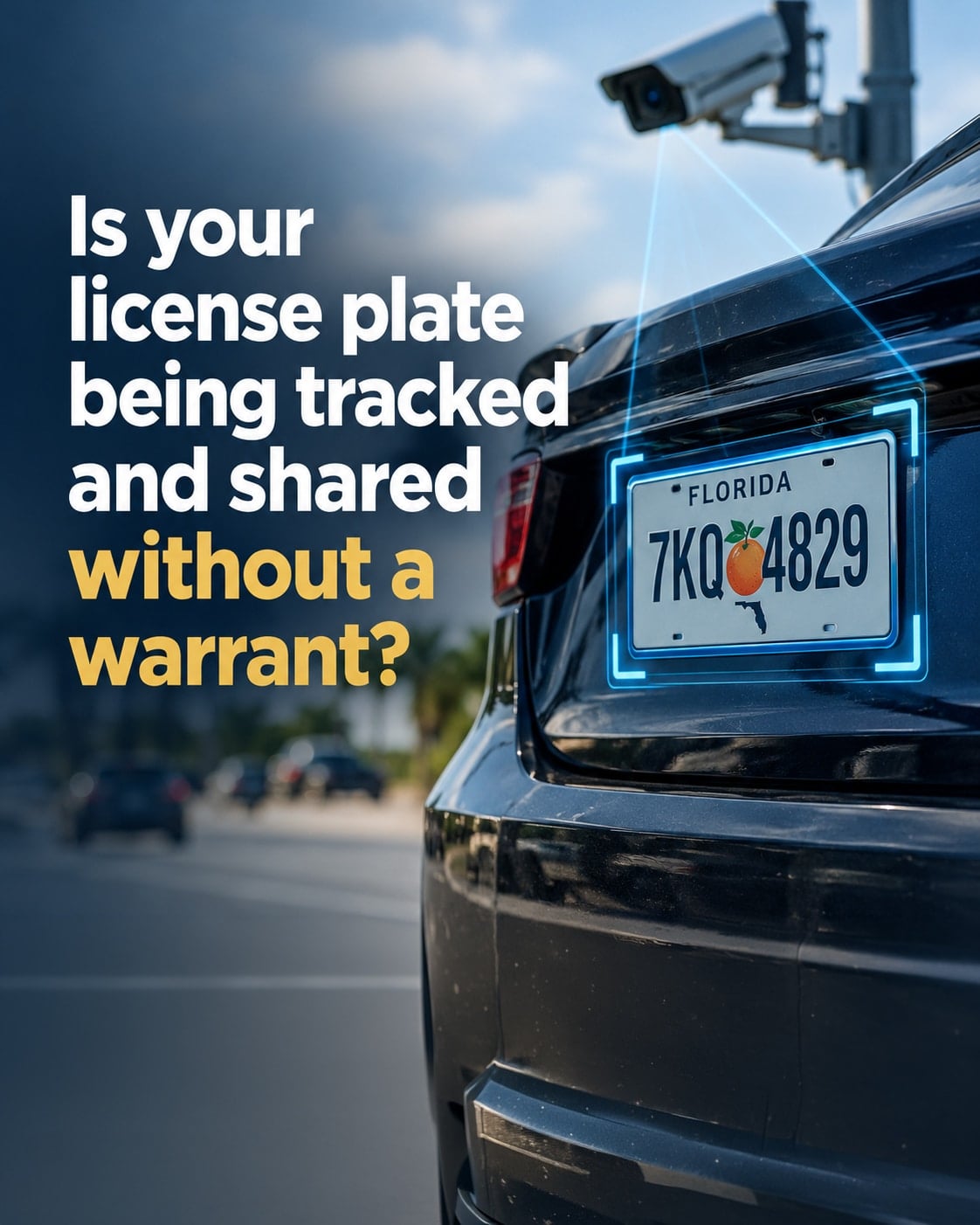
A doctor in Port St. Lucie sued his own city this year, and a federal judge in Fort Pierce now has to answer a question nobody in Florida has fully settled. Does the government need a warrant before it tracks where your car has been.
Steven Greer, a physician who lives in Port St. Lucie, filed the case without a lawyer. The operative complaint, an amended complaint filed September 11, 2026, names the City of Port St. Lucie, Mayor Shannon Martin, and Flock Group, Inc., doing business as Flock Safety, the company behind the automated cameras that read and store license plate data. The case is Greer v. City of Port St. Lucie, Florida, No. 2:26-cv-14319-AMC, pending in the United States District Court for the Southern District of Florida before Judge Aileen M. Cannon. Greer represents himself, which federal law allows any party to do in a civil case.
What the suit says
According to news coverage of the amended complaint, Greer says the city operates 126 camera devices scanning passing vehicles, a mix of Flock cameras and Axon license plate readers, and that each scan feeds a searchable network other agencies can query. He also claims the city used the cameras to track a specific pedestrian and shared camera footage with the press. None of that is a court finding. It is one side’s version of events, laid out in a complaint, and the city has not yet had to answer it on the merits.
What has actually happened in court so far tells its own story. Judge Cannon has twice denied Greer emergency requests to stop the camera program while the case proceeds, first in September and again two weeks later, finding he had not shown the kind of irreparable harm a preliminary injunction requires. She also struck several filings Greer made outside the rules and warned that more of them could bring sanctions, citing Moon v. Newsome, 863 F.2d 835, 837 (11th Cir. 1989). The court was careful to say none of that reflects a view on the merits. In the judge’s own words, nothing in those orders should be read to express an opinion on the merits of the claims, which remain active in the amended complaint. The city and Flock have until November 9, 2026 to respond.
Why the Fourth Amendment question is still open
The Fourth Amendment bars unreasonable searches. In Carpenter v. United States, 585 U.S. 296 (2018), the Supreme Court held that a person keeps a reasonable expectation of privacy in the record of where his cell phone has been, and that the government generally needs a warrant to get that history from a carrier. The Court called the ruling narrow, and lower courts have spent the years since arguing over how far it reaches into other kinds of location data, including license plate networks.
The Eleventh Circuit, which covers every federal court in Florida, has already brushed against this exact issue without resolving it. In United States v. Mapson, 96 F.4th 1323, 1334 to 1335 (11th Cir. 2024), the court let an officer’s warrantless search of a license plate database stand, but only because the officer relied in good faith on older circuit law that predated Carpenter. The panel did not decide whether warrantless access to a license plate database violates the Fourth Amendment today. That precise question, the one Greer is asking a federal judge to answer in Port St. Lucie, is still open in the circuit that governs Florida.
What Florida law does and does not require
Florida does regulate some of this technology, just not in the way most people assume. Section 316.0778, Florida Statutes, requires the Department of State to set a maximum retention period for images and data these systems collect. A companion statute, section 316.0777, covers cameras the Department of Transportation allows in the right of way of state highways at a law enforcement agency’s request, and it bars using those specific cameras to issue a traffic citation. Neither statute requires a warrant before a local agency shares plate data into a shared, searchable database, and neither one squarely addresses a city run camera network of the kind Port St. Lucie is accused of operating. The statute book has not caught up with how this technology is actually deployed, and that gap is a large part of what this lawsuit is fighting over.
Why this reaches beyond Port St. Lucie
Camera networks built on this same technology now sit along roads throughout Martin, St. Lucie, Indian River, and Palm Beach County. The stakes are not abstract. A Palm Coast woman, Lindsey Isaacs, spent thirteen days in jail this year after investigators tied her car to a deadly Interstate 4 crash using Flock camera data, even though a later reconstruction found no damage supporting a collision and pointed to a different vehicle entirely. Prosecutors dropped all eight charges against her in May. She testified about the experience before a United States Senate subcommittee in September, and her own federal civil rights suit against the troopers involved, Isaacs v. Jateff, No. 6:26-cv-01263 (M.D. Fla.), is pending. Different county, same technology, same unanswered question about who gets to search this data and on what authority.
If you believe a license plate database contributed to a stop, a search, or an arrest that should not have happened, that is a Fourth Amendment question worth having a lawyer look at before you assume nothing can be done. This area of law is moving, not settled, and the specific facts of your stop will often decide whether a court ever reaches the constitutional question at all.
General information, not legal advice. Every case is different.
The Law Offices of Travis R. Walker, P.A.
1100 SE Federal Highway, Stuart, Florida 34994
(772) 708 0952
www.TravisWalkerLaw.com