


Florida Divorce Process: A Step-by-Step Walkthrough to Your Final Judgment
Ending a marriage is a significant life event, and understanding the legal path ahead is the first step toward regaining control. The Florida divorce process, governed by Florida Statutes Chapter 61, is a structured legal procedure designed to equitably resolve all aspects of your marriage, from assets and debts to parenting plans and support.
Whether you are facing a cooperative separation or a highly contested battle, this guide walks you through the entire Florida divorce process, explaining what happens at each stage, how long it typically takes, and how to protect your rights along the way.
How the Florida Divorce Process Begins: Filing and Residency
Before a Florida court can grant your divorce, specific legal requirements must be met. The process officially begins with paperwork, but it starts with preparation.
Meeting Florida’s Residency Requirement
You cannot file for divorce in Florida unless you or your spouse has lived in the state for at least six months before filing. This is a strict requirement; if you file too early, the court lacks the jurisdiction to hear your case. You will need a Florida driver’s license, voter registration, or other documentation to prove this.
Filing the Petition for Dissolution of Marriage
The process kicks off when one spouse, known as the Petitioner, files a Petition for Dissolution of Marriage with the circuit court in the correct county. This document outlines the basic facts of your marriage and states that it is “irretrievably broken” (Florida is a no-fault state, so you do not need to prove wrongdoing).
Along with the petition, you must file several mandatory forms:
- Financial Affidavit: A sworn statement of your income, expenses, assets, and liabilities.
- UCCJEA Affidavit: If you have minor children, this document provides details about their residence and any existing custody orders.
- Filing Fee: Expect to pay a filing fee, typically around $400, though this varies by county. If you cannot afford it, you may request a fee waiver based on indigency.
Notifying Your Spouse: Service of Process
Once the petition is filed, the court needs to ensure the other spouse—the Respondent—is officially notified. You cannot simply text or email them; they must be legally served.
Service of process involves delivering a copy of the petition and a summons to the Respondent. This can be done by:
- The county sheriff’s department.
- A private professional process server.
- A waiver of service, if your spouse is cooperative and agrees to sign a document acknowledging receipt.
Once served, the clock starts ticking. The Respondent has 20 days to file a written response with the court (or 30 days if they were served outside of Florida). Ignoring the petition does not stop the divorce; it can lead to a default judgment where the Petitioner gets everything they asked for.
The "Discovery" Phase: Achieving Full Financial Transparency
Florida law demands honesty. Both parties are required to provide a full and accurate picture of their finances. This phase is often the most time-consuming but is critical for a fair outcome.
Mandatory Financial Disclosure
Within 45 days of the Respondent being served, both parties must automatically exchange specific financial documents without waiting for a formal request. This “mandatory disclosure” includes:
- Tax returns for the last three years.
- Pay stubs and proof of income.
- Bank and credit card statements.
- Retirement account summaries.
- Statements for any other assets or debts.
If you suspect your spouse is hiding assets, this is the stage where your attorney can use formal discovery tools like depositions (in-person questioning under oath) or interrogatories (written questions) to dig deeper.
Navigating Children and Parenting Requirements
If you have minor children together, the Florida divorce process requires additional steps designed to protect their well-being.
The Mandatory Parenting Course
Both parents must complete a court-approved Parent Education and Family Stabilization Course. This is a 4-hour class (often available online or in person) that teaches parents how to help their children cope with the divorce. You must file the certificate of completion with the court before a final hearing can be held.
Crafting a Parenting Plan
You cannot simply decide who gets the kids on weekends. Florida law requires a detailed Parenting Plan. This court-filed document must outline:
- A time-sharing schedule (including holidays and school breaks).
- How major decisions (education, healthcare) will be made.
- How parents will communicate with each other and the children.
The Two Paths of the Florida Divorce Process
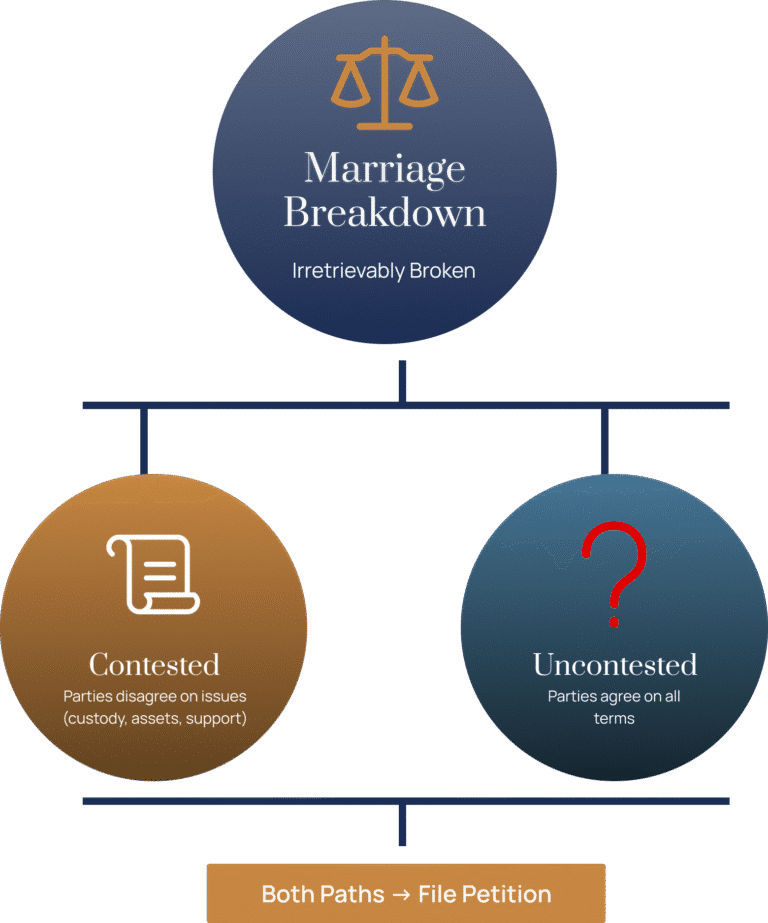
At this point, your case will proceed down one of two distinct roads: the Uncontested Path (cooperative) or the Contested Path (litigated). Your timeline and costs depend heavily on which path you take.
The Uncontested Path: Settlement and Agreement
If you and your spouse can communicate and compromise, you can save significant time and money. This path involves negotiating a Marital Settlement Agreement (MSA) . This comprehensive document covers everything: who gets the house, how debts are split, and if alimony is paid.
Once the MSA is signed (along with the Parenting Plan), the case moves toward a final hearing. In many counties, this hearing is brief—often lasting only 10 to 15 minutes—where a judge simply reviews the agreement to ensure it is fair and then signs the Final Judgment.
The Contested Path: Mediation and Trial
If you cannot agree on major issues, the process becomes more formal and adversarial. Before a judge will allow a trial, however, Florida law requires most couples to attempt mediation.
- Mediation: You and your spouse meet with a neutral, trained mediator who helps facilitate settlement discussions. The mediator does not take sides but helps identify solutions. Remarkably, over 90% of cases settle at this stage. If you reach an agreement in mediation, it is written into an MSA, and you proceed to the uncontested final hearing.
- Trial: If mediation fails, the case goes to trial. This is a formal court proceeding where both sides present evidence, call witnesses, and make legal arguments. The judge then acts as the decision-maker, issuing a Final Judgment that resolves all contested issues. Trials are expensive, time-consuming, and leave the outcome in the hands of the court.
Reaching the Finish Line: The Final Judgment
Regardless of your path, the Florida divorce process concludes with the judge signing the Final Judgment of Dissolution of Marriage.
This document is the official court order that:
- Legally ends your marriage.
- Ratifies the Marital Settlement Agreement (or outlines the judge’s rulings from trial).
- Finalizes the Parenting Plan and child support obligations.
- Sets the terms for any alimony payments.
Once the judge signs it, you are legally single.
Life After Divorce: Post-Judgment Steps
The Final Judgment is the end of the marriage, but it often requires follow-up actions to fully implement the court’s orders:
- QDROs: If retirement accounts (like 401(k)s) were divided, a separate court order called a Qualified Domestic Relations Order (QDRO) is needed to transfer the funds without penalties.
- Transferring Assets: Deeds for real estate need to be signed and recorded. Car titles need to be transferred.
- Updating Beneficiaries: You must update beneficiaries on life insurance policies, wills, and retirement accounts to reflect your new wishes.
The Florida divorce process is complex, but you do not have to navigate it alone. Understanding the framework helps you make informed decisions, whether you are aiming for an amicable settlement or preparing to protect your interests in court.
Contact our office today to discuss your specific situation and learn how we can guide you through every step of the Florida divorce process.
If you want to view this process in a visual presentation, please visit here to view our Florida Divorce Process Flowchart: A Visual Guide.